Many parents assume their child’s vision is fine as long as they are not squinting or complaining about blurry sight. The reality is that most children cannot identify or communicate vision problems because they have never known what clear, healthy vision feels like. A pediatric eye doctor is trained specifically to detect what children cannot describe, and catching eye conditions early is the single most important factor in determining how well a child’s vision develops for the rest of their life.
This guide covers the right age to schedule an exam, the warning signs that demand immediate attention, the full spectrum of conditions a pediatric eye doctor can diagnose and treat, and what to expect when you bring your child in for care.
Why Early Eye Care Matters
The brain and the visual system develop together. During the first several years of life, the brain is actively learning to process information from both eyes. If one or both eyes are sending distorted or inconsistent signals due to refractive errors, strabismus, or other eye conditions, the brain begins to compensate in ways that permanently affect vision. Once that critical developmental window closes, treatment becomes far more difficult and outcomes are less certain.
Pediatric eye care exists precisely because children’s eyes are not simply smaller versions of adult eyes. They are developing organs, and the diseases, disorders, and vision problems that affect them behave differently and often require entirely different approaches to diagnosis and treatment. Early identification through a comprehensive eye exam gives young patients the best possible chance at full visual development.
For a closer look at what a professional exam involves, visit our Pediatric Eye Exam page to see exactly what your child can expect.
When to Schedule Your Child's First Eye Exam
The American Optometric Association gives clear guidance, and a pediatric optometrist follows these benchmarks for initial scheduling:
- 6 months old: The first comprehensive eye exam. A pediatric eye doctor checks for eye alignment issues, focusing ability, and early eye health concerns including retinopathy of prematurity in infants born preterm.
- Age 3: A full vision evaluation to identify refractive errors, early amblyopia (lazy eye), or crossed eyes before school years begin.
- Age 5 to 6: Before starting school, when undetected vision issues most directly interfere with learning, reading, and development.
- Annually from school age onward: Children’s eyes change rapidly, and an annual exam with a children’s eye doctor catches shifts in prescription and monitors conditions that were previously identified.
Do not wait for a school screening to substitute for a proper exam. School screenings are pass/fail tools that identify some children with poor vision but miss many others, particularly those with amblyopia or early-stage eye disorders that do not yet affect standard acuity tests.
Warning Signs That Mean See a Doctor Now
Between scheduled visits, certain symptoms in your child’s eyes should prompt you to contact a pediatric eye doctor without delay:
- One eye turning inward or outward (crossed eyes or strabismus)
- Closing or covering one eye to read or watch television
- Tilting or turning the head consistently to one side
- Complaints of double vision, frequent headaches, or tired eyes
- Unusual sensitivity to light
- White, yellow, or cloudy appearance in the pupil (a potential sign of pediatric cataracts or other serious eye conditions)
- Excessive tearing or redness that does not resolve on its own
- Difficulty focusing during schoolwork or noticeably falling behind in reading
A children’s optometrist can distinguish between conditions that need monitoring and those that require immediate intervention. When symptoms suggest something beyond routine correction, such as childhood glaucoma or more complex eye disorders, your care team will coordinate with the appropriate ophthalmology specialists.
Conditions a Pediatric Eye Doctor Can Diagnose and Treat
Pediatric eye care covers a wide range of conditions that affect children differently than adults. Here is what a thorough evaluation can identify:
Refractive Errors
Nearsightedness (myopia), farsightedness (hyperopia), and astigmatism are the most common vision issues affecting children. Left uncorrected, they make it harder for kids to read, participate in class, and develop properly. Glasses or contact lenses address these directly, and myopia in particular may benefit from Myopia Control Therapy to slow its progression during the years the eyes are still developing.
Amblyopia (Lazy Eye)
Amblyopia occurs when one eye develops weaker visual connections to the brain due to a significant difference in prescription or misalignment between the two eyes. It is one of the most common causes of poor vision in children and responds well to treatment when caught early. Treatment typically involves correcting the underlying refractive error, patching the stronger eye to stimulate the weaker one, or in some cases using atropine drops as medications to blur the dominant eye temporarily.
Strabismus (Crossed Eyes)
Strabismus is a misalignment of the eyes that prevents them from focusing together. It can cause amblyopia if untreated and in more complex cases may require surgical care to realign the eye muscles. A pediatric optometrist will diagnose and co-manage strabismus, working alongside pediatric ophthalmologists or an ophthalmology team when surgery or more advanced intervention is needed.
Childhood Glaucoma
Childhood glaucoma is rare but serious. It involves elevated pressure inside the eye that can damage the optic nerve and lead to irreversible vision loss. A pediatric eye doctor tests eye pressure as part of a comprehensive exam, and early diagnosis is critical. Our Glaucoma Management services provide ongoing monitoring and treatment planning for patients at risk.
Retinopathy of Prematurity
Infants born prematurely are at risk for retinopathy of prematurity, a condition where abnormal blood vessels develop in the retina. It requires specialized monitoring from early infancy. Pediatric ophthalmologists with retinopathy expertise may become involved in complex cases, coordinating with your child’s broader medical team and, where necessary, the neurology and general pediatrics departments of a hospital.
Pediatric Cataracts
Pediatric cataracts can be present at birth or develop in early childhood. Unlike cataracts in older adults that progress slowly, pediatric cataracts can interfere with visual development very quickly and often require prompt surgical care followed by vision therapy or optical correction to ensure the brain develops proper visual pathways.
Special Needs Patients
Children with special needs, including those with neurological conditions, Down syndrome, cerebral palsy, or other developmental disorders, have a higher rate of undetected vision problems. A children’s eye doctor experienced with this population understands how to conduct a meaningful exam without relying solely on verbal responses, and how to support families in managing the added complexity of vision care for children with multiple diagnoses.
For a full overview of what our practice offers children, browse our complete services page.
What to Expect at a Pediatric Eye Exam
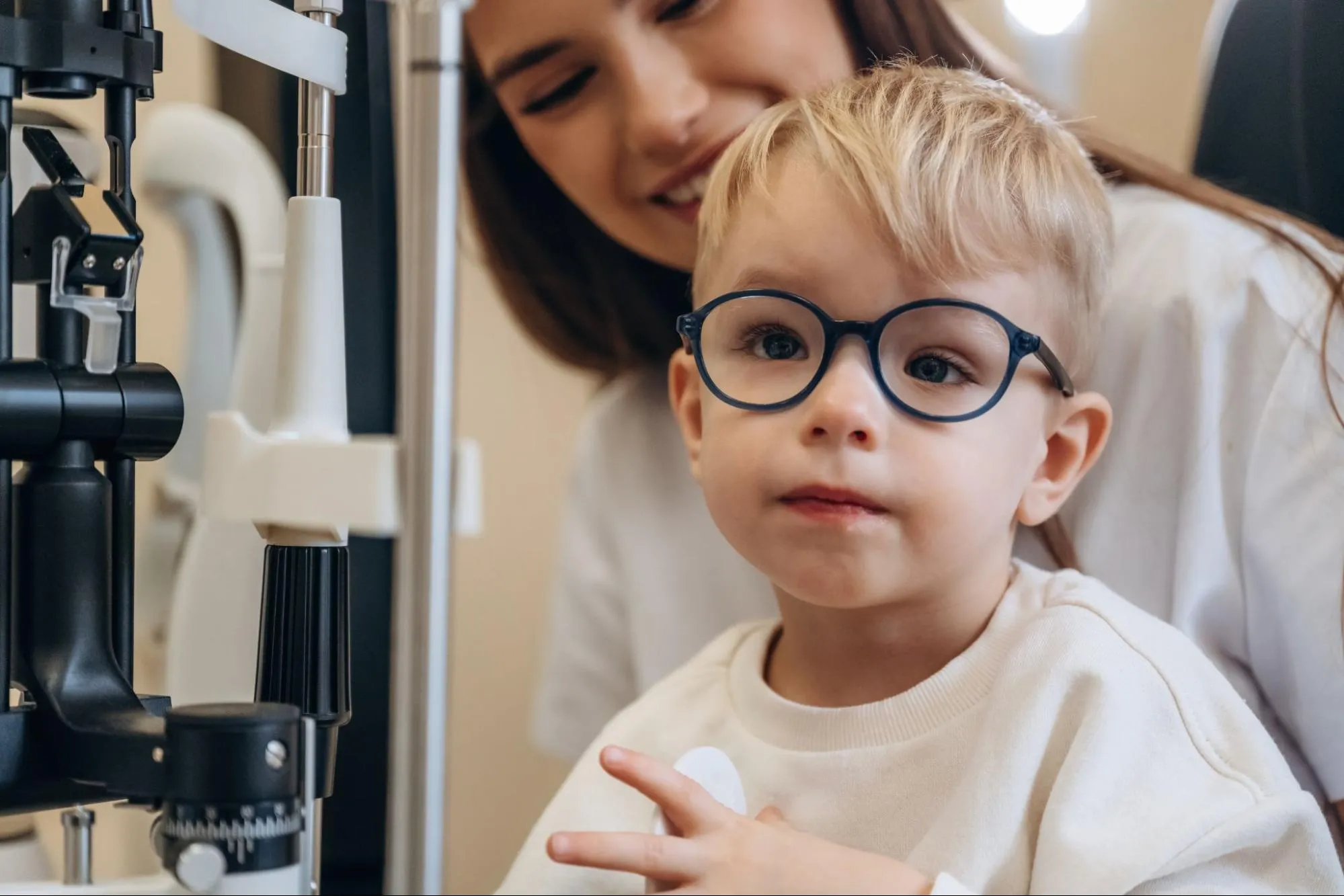
The exam itself is designed to be comfortable and age-appropriate. There is nothing to be nervous about, and a skilled children’s optometrist knows how to keep young patients engaged.
For infants, the exam uses light reflexes, observation of gaze and visual tracking, and the red reflex test. No verbal response is required. For toddlers and preschool-aged children, age-appropriate symbols and matching games replace the standard letter charts. For school-age children, a full evaluation includes acuity testing, assessment of focusing and eye teaming, color vision screening, depth perception testing, and a thorough evaluation of eye health including the optic nerve and retina.
In some cases, dilating eye drops are used to give the doctor a clearer view of the internal structures of the eye, including assessing the lens for early signs of pediatric cataracts and checking the health of the retina. Your doctor will let you know in advance if this is planned.
If your child needs glasses after their exam, our same day glasses service means they can leave with their new prescription in hand without a second trip.
And if you have questions about understanding your child’s prescription, our blog post How Bad Is My Eye Prescription? covers everything in plain language.
Pediatric Eye Care vs. General Eye Care
A general optometrist provides excellent care for adults and routine vision needs. A pediatric optometrist brings additional training in child development, age-appropriate testing protocols, and the management of pediatric-specific eye conditions that rarely or never occur in adults.
Pediatric eye care also involves a communication layer that general exams do not require. Explaining what is happening to a four-year-old in a way that is honest, calm, and reassuring is a skill that takes practice. At 414 Eyes, our team is trained in exactly that, and many parents are surprised by how quickly children relax during the exam process.
When eye conditions require coordination beyond optometry, such as oculoplastic surgery, surgical care for strabismus, or oncology-related retinal concerns, your children’s eye doctor at 414 Eyes will work directly with the appropriate specialists so your family has a clear path forward without navigating a fragmented system alone.
If you are wondering about specific eye tests used during exams, our post on In-Office vs. Online Eye Tests explains why an in-person exam is always the right choice, especially for children.
For parents with concerns about color vision, our Color Blind Test guide covers how color blindness is identified and what it means for your child’s everyday life.
Book Your Child's Eye Exam at 414 Eyes
Your child’s vision is foundational to how they learn, grow, and experience the world. Do not leave it to chance or rely on school screenings alone. The expert pediatric eye care team at 414 Eyes in Milwaukee is ready to welcome your family, make the process easy and comfortable, and give you a clear picture of your child’s visual health.
You can also learn more about related conditions and care in our blog posts on eye twitching in children and adults, eyelid bumps and lumps explained, and Stargardt disease in young patients.
Schedule a Pediatric Eye Exam at 414 Eyes Today and give your child the clear start they deserve.
FAQs
At what age should my child see a pediatric eye doctor for the first time?
The first visit should happen at around six months of age, then again at three years old, and once more before starting school. After that, annual exams with a pediatric optometrist are recommended.
What is the difference between a pediatric optometrist and a pediatric ophthalmologist?
A pediatric optometrist provides comprehensive eye exams, diagnoses vision problems, and prescribes glasses or contacts. Pediatric ophthalmologists specialize in surgical care and medical treatment of more complex eye conditions like strabismus, childhood glaucoma, and pediatric cataracts. Both work together when needed to provide a full spectrum of care.
How do I know if my child has amblyopia (lazy eye)?
Amblyopia often has no obvious symptoms, which is exactly why a routine comprehensive eye exam is essential. Some children may favor one eye, close one eye when reading, or have difficulty with depth perception, but many show no visible signs at all. Only an eye exam can diagnose it.
Can a children's eye doctor test an infant who cannot speak or read?
Yes. A children’s eye doctor uses objective techniques including light reflexes, pupil response tests, the red reflex test, and retinoscopy to evaluate vision in infants without any verbal participation required.
What causes crossed eyes in children?
Strabismus (crossed eyes) can be caused by refractive errors, muscle imbalances, neurological factors, or in some cases it can be associated with other conditions. It is important to have it evaluated by a pediatric eye doctor promptly, as untreated strabismus can lead to amblyopia and long-term vision problems.
Does my child need glasses if they have been diagnosed with amblyopia?
In most cases, yes. Correcting the underlying refractive error with glasses is typically the first step in amblyopia treatment. Patching or medications may be added based on how the child responds and how significant the vision difference is between the two eyes.
Can vision problems affect my child's performance in school?
Absolutely. Undetected refractive errors, amblyopia, and eye teaming problems are among the most common and most overlooked causes of reading difficulties and academic struggles. Many children labeled as having attention issues are actually dealing with uncorrected vision issues. A comprehensive exam with a pediatric optometrist rules out vision as a contributing factor.
My child passed a school vision screening. Do they still need an eye exam?
Yes. School screenings are basic and miss many conditions, including amblyopia, early-stage childhood glaucoma, and refractive errors that fall just within passing range. A full comprehensive eye exam with a children’s optometrist is a completely different level of evaluation.
What is retinopathy of prematurity?
Retinopathy of prematurity is a condition where abnormal blood vessels grow in the retina of premature infants. It can range from mild and self-resolving to severe, where surgical care is needed to prevent retinal detachment and vision loss. Infants born before 30 weeks or with a low birth weight should be evaluated by a specialist with training in retinopathy.
Does 414 Eyes see children with special needs?
Yes. Our team is experienced in providing pediatric eye care for children with special needs, including those with neurological conditions and developmental differences. We adapt the exam to each child’s needs and take the time required to get accurate results.